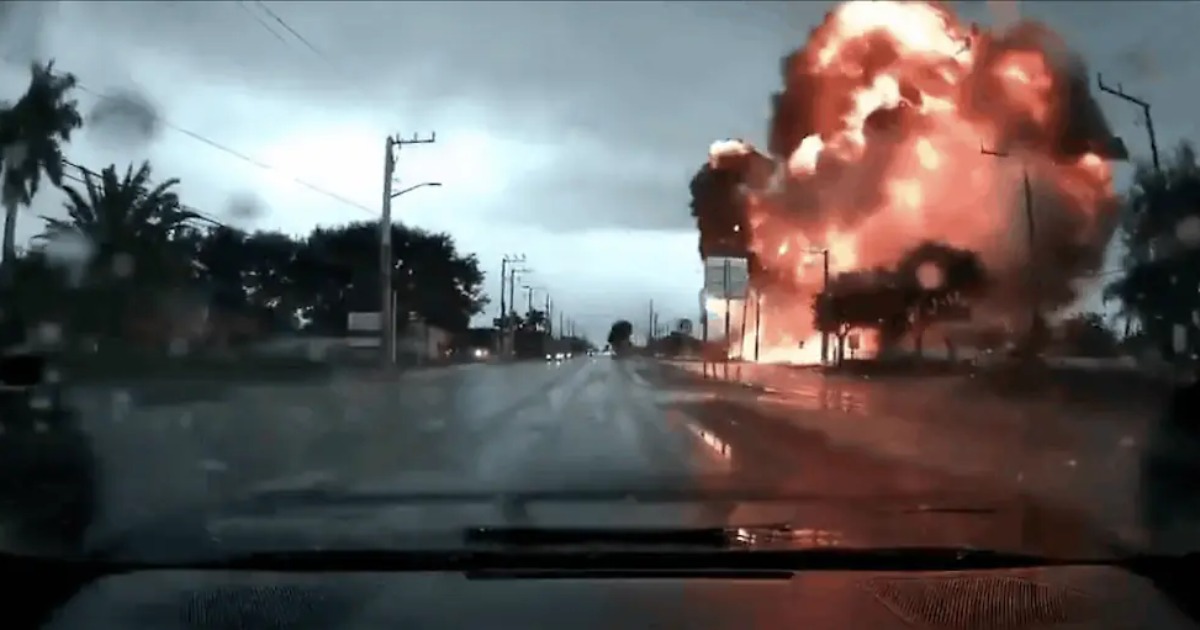

Aviation experts have raised questions about a potentially dangerous high-altitude flying phenomenon following the Florida private jet crash that killed all nine people on board.
The Learjet 60 was travelling from Austin, Texas, to North Eleuthera in the Bahamas when it crashed into a residential area of Greenacres, Palm Beach County, on Sunday, November 1, 2026.
The aircraft came down at approximately 12:50pm local time and erupted into flames, prompting an emergency response and the closure of nearby roads.
As federal investigators examine the circumstances surrounding the disaster, aviation specialists have discussed several possible explanations, including a phenomenon known as 'coffin corner'.
However, officials have not confirmed the cause of the crash, and the theories currently circulating should not be mistaken for the findings of the investigation.
What is the 'coffin corner' theory?
One theory being discussed by aviation commentators involves a dangerous condition known in aviation as coffin corner.
The term describes a situation at high altitude where the difference between an aircraft's minimum safe airspeed and its maximum permitted airspeed becomes extremely narrow.
Aircraft must maintain sufficient speed to generate lift, but flying too quickly at high altitude can also create dangerous aerodynamic effects.
As an aircraft climbs, the margin between these two limits can decrease.
Eventually, the aircraft may reach a point where there is very little room to increase or decrease its speed without encountering potentially hazardous conditions.
According to aviation safety resource SKYbrary, coffin corner occurs when the boundary associated with a low-speed stall approaches the boundary associated with the aircraft's critical Mach number.
In simpler terms, pilots may find themselves operating within an unusually narrow range of safe speeds.
Why can coffin corner be dangerous?
There are two main aerodynamic hazards associated with this situation.
If an aircraft slows too much, it can approach an aerodynamic stall, where the wings no longer produce sufficient lift to maintain controlled flight.
At the opposite end of the speed range, approaching the aircraft's critical Mach number can produce compressibility effects, including shock waves and changes in airflow that may affect handling.
Both situations can become particularly challenging at high altitude, where the air is thinner and an aircraft's performance margins may be reduced.
Modern aircraft are designed with operating limits and procedures intended to help crews avoid these conditions.
Nevertheless, unexpected changes in weather, turbulence or aircraft performance can complicate the situation.
Former pilot suggests weather may have played a role
Former pilot Martin Varsavsky discussed the possibility of coffin corner in a social media post following the Florida crash.
He suggested that changes in atmospheric conditions, particularly those associated with storms, can affect an aircraft's ability to maintain safe flight at a given altitude.
Varsavsky argued that changes in outside air temperature can alter the conditions in which an aircraft operates, potentially making it more difficult to maintain control.
His comments raised the possibility that weather conditions could have contributed to an aerodynamic problem.
However, this remains a theory rather than an established explanation of what happened to the Learjet.
Investigators would need to examine the aircraft's actual altitude, speed, atmospheric conditions and other flight data before determining whether coffin corner was relevant.
What do we know about the final audio?
The aircraft's final communications have attracted attention following reports about the circumstances of the crash.
However, the published reporting does not provide a verified transcript or recording of the Learjet's final air traffic control communications.
It is therefore not possible to establish from the available material exactly what was said by the pilots during the aircraft's final moments.
Any recordings, communications data or other evidence obtained by investigators may help establish the sequence of events.
Until that information is publicly authenticated, claims about specific words spoken in the cockpit or over the radio should be treated cautiously.
Investigators find evidence aircraft may have broken apart before impact
One of the most significant developments emerged on Monday, November 2, when investigators provided an update about the wreckage.
According to reports, investigators identified preliminary evidence suggesting the aircraft may have begun breaking apart before it struck the ground.
Such a finding could become important in determining the sequence of events leading to the crash.
However, evidence of an in-flight breakup does not, by itself, establish why the aircraft lost structural integrity.
Investigators may need to consider several possible factors, including aerodynamic forces, structural damage, weather conditions and the aircraft's flight characteristics.
The National Transportation Safety Board is leading the investigation, with assistance from the Federal Aviation Administration.
Who were the nine victims?
All seven passengers and two crew members died in the crash.
The victims have been identified as:
The victims' families have since issued emotional statements remembering their loved ones and asking for privacy as they grieve.
Robinson's company also paid tribute to its CEO, remembering him as a mentor and an influential figure within the technology industry.
Could weather have caused the Learjet crash?
Weather conditions are expected to form part of the investigation, particularly given the discussion surrounding the aircraft's high-altitude performance.
Temperature, turbulence and other atmospheric conditions can affect aircraft handling and performance.
However, investigators have not confirmed that weather caused the Learjet to lose control or break apart.
The possibility of an aerodynamic stall, high-speed buffet or another flight-control problem remains speculative without supporting evidence.
Experts examining the incident from outside the official investigation may offer useful explanations of aviation hazards, but those explanations do not necessarily describe what occurred during this particular flight.
What happens next in the investigation?
The NTSB is expected to examine available flight data, aircraft maintenance records, weather information, wreckage and communications as part of its investigation.
Investigators may also assess the aircraft's structural condition and the circumstances surrounding its final descent.
The process of determining a probable cause can take considerable time, particularly when an accident involves a possible in-flight breakup.
For now, the coffin corner theory offers one possible area of discussion, but it has not been established as the cause of the tragedy.
As the families of the nine victims mourn their loved ones, investigators continue working to determine exactly what happened aboard the Learjet 60 before it crashed in Florida.