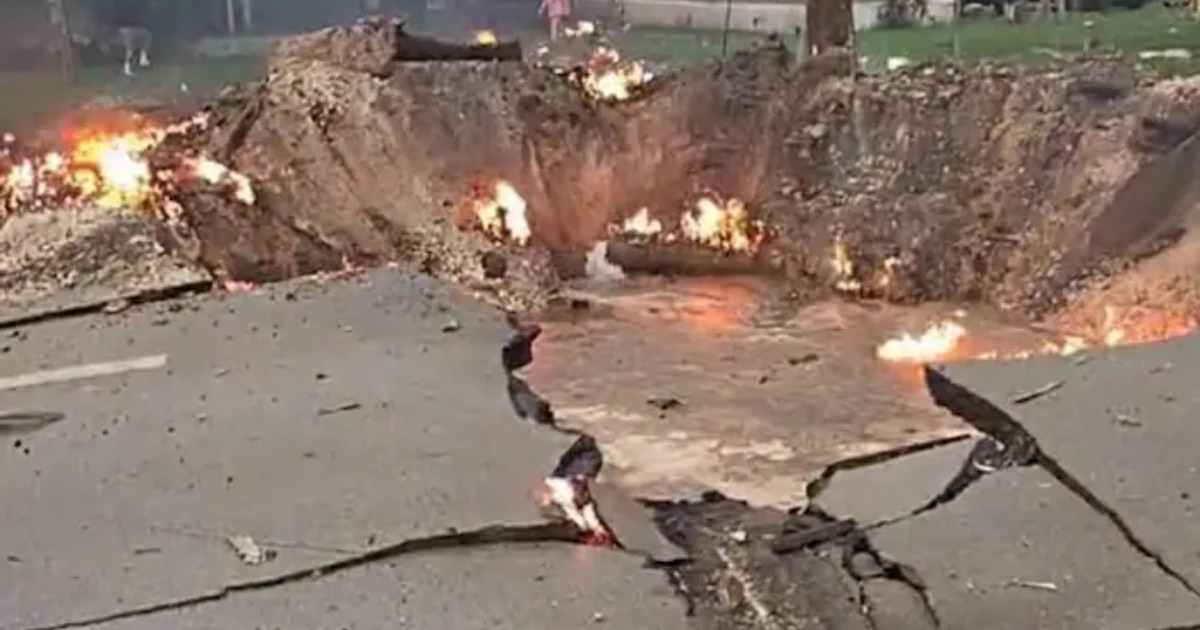

An aviation expert has addressed growing speculation surrounding the devastating Florida Learjet crash that killed nine people, explaining why so little recognisable wreckage appeared to remain at the scene and discussing a possible explanation for the aircraft's final moments.
The private Learjet 60 crashed near Greenacres in Palm Beach County, Florida, on Sunday, November 1, 2026, after departing Austin-Bergstrom International Airport in Texas.
The aircraft had been travelling to North Eleuthera in the Bahamas when it came down near Military Trail, erupting into flames.
All seven passengers and two crew members were killed.
As footage of the crash and its aftermath circulated online, viewers began questioning the apparent lack of large aircraft components at the scene.
Now, aviation commentator and pilot Dan Millican has addressed those concerns while warning against treating unverified theories as facts.
Why was there so little wreckage at the crash site?
One of the biggest questions raised online concerned the apparent absence of recognisable aircraft wreckage following the crash.
Videos from the scene showed a large area of destruction, but some viewers questioned why there were no obvious intact wings or other large sections of the Learjet.
Speaking on the Taking Off YouTube channel, Millican explained that the force of a high-speed impact can break an aircraft into extremely small fragments.
He said: "A plane coming down that hard and that fast basically vaporizes."
His explanation was that the aircraft's structure would be subjected to enormous forces upon impact, leaving very little that resembled a complete aeroplane.
Although Millican used the word "vaporizes", this should not be taken to mean the entire aircraft literally turned into vapour.
Instead, a high-energy collision can fragment much of the structure into pieces that are difficult to identify in photographs or video footage.
Learjet-rated captain Dwight Ingram offered a similar explanation in comments to CBS News.
He said that heavier components, such as engine parts and landing gear, could still be present among the debris, even if much of the aircraft had shattered into small fragments.
Investigators are expected to carefully document and recover the wreckage as part of their examination of the crash.
Aviation expert discusses possible icing theory
Millican also discussed a theory involving ice accumulation on the aircraft, particularly around its tail.
He highlighted a pilot weather report recorded at approximately 12:45pm on the day of the crash.
The report described light clear icing at an altitude of around 35,000 feet, with an outside temperature of approximately minus 46 degrees Celsius.
Moderate turbulence and precipitation were also reportedly encountered.
However, the weather report did not include the aircraft's registration number, meaning it has not been established whether it came from the Learjet involved in the fatal accident.
Millican stressed that evidence of icing conditions would not automatically prove that ice caused the aircraft to crash.
The aircraft's anti-icing systems, including equipment designed to protect the tail, may nevertheless be relevant to the investigation.
How could ice on the tail affect an aircraft?
The horizontal stabiliser is a wing-like structure at the rear of an aircraft that helps maintain its balance and pitch control.
Under certain conditions, ice can change the airflow over this surface and interfere with its aerodynamic performance.
If the stabiliser experiences an aerodynamic stall, the aircraft may become difficult to control and could pitch unexpectedly.
Millican said he had spoken with a Learjet specialist who raised concerns about the reliability of the aircraft's tail anti-icing equipment.
According to the theory discussed, ice accumulation could potentially have contributed to a loss of control during a climb.
The proposed sequence involved a possible tailplane stall, followed by a rapid increase in speed and structural failure.
However, this is an unconfirmed scenario. Investigators have not established that the aircraft encountered dangerous ice accumulation, suffered a tailplane stall or experienced the proposed sequence of events.
Have Learjet anti-icing systems raised concerns before?
The discussion has also drawn attention to previous aviation safety concerns involving Learjet anti-icing equipment.
In 1999, the Federal Aviation Administration ordered a one-time inspection of anti-icing wiring on certain Learjet aircraft, including some Learjet 60 models.
The action followed a malfunction involving a Learjet 55 that had experienced severe buffeting.
However, a historical safety directive does not establish that the Learjet involved in the November 2026 crash suffered the same problem.
Investigators would need to examine the specific aircraft's maintenance history, equipment condition and available flight data before drawing conclusions.
Did the Learjet lose its wings before crashing?
Another theory circulating online involves footage captured by a vehicle's dashboard camera.
Some viewers suggested that the descending aircraft appeared to be missing its wings or horizontal stabiliser.
Millican cautioned against drawing firm conclusions from the images.
He explained that the aircraft's wings were similar in colour to the clouds behind it, making them difficult to distinguish in some frames.
In at least one frame, he believed both wings appeared to be visible.
However, the footage was not sufficiently clear to establish whether particular aircraft components had separated before impact.
That question will require a detailed examination of the physical wreckage and other available evidence.
Investigators find evidence of possible midair breakup
During a press conference on Monday, November 2, the National Transportation Safety Board revealed that investigators had found preliminary evidence suggesting the aircraft may have begun breaking apart before reaching the ground.
Investigators were documenting debris found away from the main crash site to determine whether components had separated while the aircraft was still airborne.
The location and distribution of wreckage can provide important clues about the sequence of an accident.
For example, pieces that separate from an aircraft before impact may be scattered over a wider area than debris produced by the final collision.
However, officials had not confirmed which components, if any, separated first.
When asked specifically about the aircraft's tail, investigators said they had not yet identified particular components associated with a potential separation.
Expert warns against spreading misinformation
Millican also addressed the emotional impact of the tragedy on the aviation community.
He explained that fatal accidents involving fellow pilots can be particularly upsetting for people working in the industry.
After initially stepping away from coverage of the crash, he said he was troubled by the amount of speculation and misinformation circulating online.
His message was that discussing possible explanations is reasonable, but presenting speculation as established fact can mislead the public.
He emphasised that the official investigation, rather than social media theories, must determine what happened.
Who were the victims of the Florida Learjet crash?
The nine people killed in the disaster included technology entrepreneur Adam Robinson, 45, and his wife Helen Sharp, 40.
The couple's two young children, Emma, four, and Charlie, two, were also killed.
Other passengers included the family's nanny, Anita Maria Cetina, and friends Rachael Reed and Charmi Fehr.
The aircraft's crew members were pilot Jeff Gregory, 55, and co-pilot Nathalia Gadelha Filgueiras, 20.
The families have released emotional tributes remembering their loved ones, while Robinson's company has described the loss as devastating.
What happens next?
The NTSB is leading the investigation, supported by the Federal Aviation Administration.
Investigators are expected to examine the aircraft's wreckage, maintenance history, weather conditions, flight information and any available communications.
Particular attention may be paid to the possibility of an in-flight breakup and the role, if any, of icing conditions.
For now, the theories discussed by aviation experts remain unproven.
Although the crash scene may appear unusual to people viewing photographs and videos online, specialists say the absence of large recognisable wreckage is not evidence of a conspiracy.
The precise cause of the fatal crash remains under investigation.