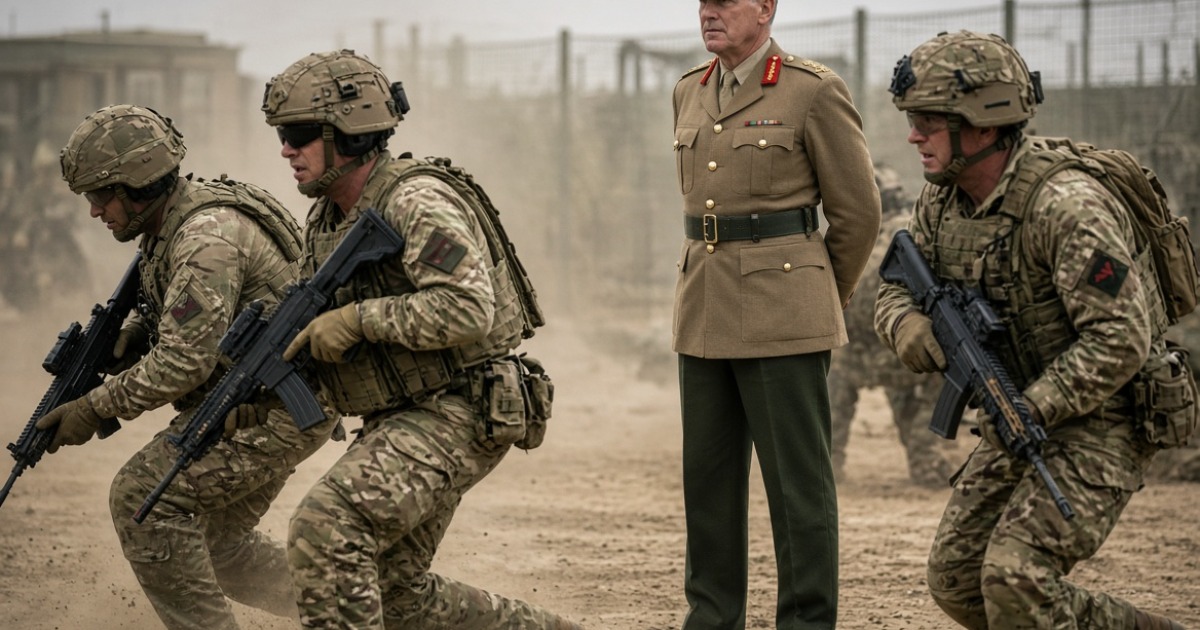

Artificial intelligence has offered an assessment of when World War 3 could potentially begin as some of Britain's most senior military and intelligence figures issue warnings about the country's security.
The discussion follows a series of statements from General Sir Roly Walker, the head of the British Army, and Sir Ken McCallum, director general of MI5.
Both have highlighted the challenges posed by an increasingly unpredictable international environment, including tensions involving Russia and other global powers.
Former national security adviser Lord Peter Ricketts has also called for greater public awareness of the threats facing Britain.
With concerns growing about the possibility of a wider international conflict, artificial intelligence has been asked to examine when another world war might occur and what it could mean for the UK.
When does AI predict World War 3 will break out?
ChatGPT's assessment was that there is no reliable way to predict when World War 3 could begin, or even whether such a conflict will happen.
When questioned by LADbible, the artificial intelligence chatbot explained that no dependable date or countdown exists for a future world war.
It acknowledged that major international conflicts can escalate unexpectedly, but stressed that current tensions do not establish that a global war is imminent.
In other words, AI did not identify a particular year, month or date when World War 3 is expected to begin.
Its response instead focused on several possible scenarios that could lead to a wider confrontation between major powers.
Those scenarios were presented as risks worth understanding, rather than predictions of events that will definitely take place.
AI-generated responses should not be treated as authoritative intelligence assessments or reliable forecasts of future wars.
What warning did the British Army chief issue?
General Sir Roly Walker delivered a serious message to approximately 700 soldiers during a visit to Catterick Garrison in North Yorkshire.
Speaking about the changing international security environment, he warned that Britain could require its armed forces to confront increasingly significant threats.
The Army chief told soldiers that the nation was going to need them and said political leaders would soon have to speak frankly with the public about preparing for potential conflict.
He explained that the conversation would involve the sacrifices that might be required to prioritise national defence and security.
Walker also argued that ordinary citizens would need to understand the military's role and support the country's wider defence efforts.
His remarks reflected concerns about the international situation rather than an announcement that Britain was entering a war.
He did not announce compulsory military service or a timetable for mobilising civilians.
Why is the British Army concerned about Russia?
Russia remains one of the principal security concerns identified by British defence and intelligence officials.
The country's ongoing confrontation with Ukraine and its increasingly strained relationship with NATO have contributed to wider European security concerns.
British officials have also warned about activities that fall short of conventional military attacks.
These can include cyber operations, sabotage, espionage and attempts to influence public opinion.
Such activities are often described as hybrid threats because they combine different methods of applying pressure without necessarily involving a formal declaration of war.
Senior British officials have argued that preparing for these risks is essential to national security.
However, identifying Russia as a major threat does not mean that a direct war between Russia and Britain has been declared or is inevitable.
What did the head of MI5 say?
Sir Ken McCallum delivered his annual threat update on October 13, 2026, warning that Britain had entered a new period of national security challenges.
He described the threats facing the country as increasingly complex, involving hostile states, terrorism and emerging technologies.
The MI5 director general warned that foreign governments and other hostile actors were attempting to exploit divisions within British society.
He also highlighted concerns about the use of artificial intelligence to support cyberattacks and other hostile activities.
According to McCallum, national security threats increasingly extend beyond traditional military confrontation.
That means disruption to infrastructure, information systems and essential services can form part of a hostile campaign even without an invading army.
His warning emphasised the importance of adapting Britain's security capabilities to these evolving challenges.
What are the biggest potential triggers for World War 3?
In its response to LADbible, ChatGPT identified several international flashpoints that could create opportunities for escalation.
These were hypothetical scenarios rather than forecasts.
1. A confrontation between Russia and NATO
One possibility involves a direct military confrontation between Russia and a NATO member state.
NATO is a military alliance whose members include the United Kingdom, the United States and numerous European countries.
Under Article 5 of the North Atlantic Treaty, an armed attack against one member can be treated as an attack against the alliance as a whole.
However, the precise response would be determined by individual allies and would not automatically require every member to take identical military action.
A confrontation involving NATO and Russia could therefore have consequences far beyond the countries directly involved.
2. A conflict involving China and Taiwan
Another potential flashpoint is the longstanding dispute over Taiwan.
China claims Taiwan as part of its territory, while Taiwan maintains its own government and democratic institutions.
Tensions in the region have prompted concerns about the possibility of military confrontation.
Because the United States maintains significant security interests in the region, a serious crisis could involve multiple countries.
However, a conflict is not inevitable, and diplomatic, economic and military developments would all influence how any confrontation unfolded.
3. A wider conflict in the Middle East
The Middle East was also identified as an area where existing tensions could potentially escalate.
Conflicts involving regional powers and their international partners can create risks of wider military involvement.
Disruption to shipping routes, energy supplies and international trade could also have consequences for countries outside the immediate region.
However, even a serious regional conflict would not automatically become a world war.
The outcome would depend on the decisions made by governments and the extent to which other countries became involved.
What would happen to Britain if World War 3 began?
According to the AI assessment, Britain's involvement would depend heavily on how a wider conflict started.
If a NATO ally were attacked, the UK would be expected to participate in the alliance's collective defence arrangements.
That could involve military forces, intelligence, logistical assistance or other forms of support.
If a conflict began outside NATO territory, Britain's response could be different.
The government might decide to provide equipment, intelligence or diplomatic assistance without committing combat forces directly.
The circumstances of any future conflict would therefore determine the nature and scale of British involvement.
There is no single predetermined scenario for how the UK would respond to a hypothetical third world war.
Could everyday life in the UK be affected?
A major international conflict could have consequences for British households even if fighting did not take place on UK soil.
Potential risks include disruption to energy supplies, transport networks, communications and financial services.
Cyberattacks could also target important infrastructure or organisations.
International trade disruptions might affect the availability and price of certain goods.
However, these are possible consequences of a severe conflict, not evidence that such disruption is about to occur.
Government emergency planning is designed to improve the country's ability to respond to a range of threats, including natural disasters, cyber incidents and international crises.
Preparing for emergencies should not be confused with predicting that a particular emergency will happen.
Will British civilians be forced to join the Army?
General Walker's remarks have raised questions about whether compulsory military service could return to Britain.
However, his speech did not announce conscription.
The United Kingdom currently operates a professional volunteer military.
Compulsory National Service ended decades ago, and there is no existing general requirement for British adults to enlist in the armed forces.
Reintroducing compulsory military service would require significant political and legal decisions.
Walker's comments about public participation and sacrifice should therefore not be interpreted as confirmation that civilians are about to receive military call-up notices.
National defence also involves activities beyond serving in the armed forces, including maintaining essential services, protecting infrastructure and strengthening emergency preparedness.
What did former national security adviser Lord Peter Ricketts say?
Lord Peter Ricketts, a former senior British diplomat and national security adviser, has also urged ministers to explain the changing international threat environment more clearly.
Speaking to BBC Radio 4's Today programme, he argued that the public should be informed about the risks associated with hostile states.
He particularly highlighted Russia's attempts to undermine confidence and stability in European countries.
His comments reflected a broader argument that national security should not be discussed exclusively within government and military circles.
Instead, the public should have an opportunity to understand the challenges and the measures being considered to address them.
Is World War 3 actually imminent?
Despite the serious warnings issued by British security officials, there is no reliable evidence establishing that a third world war is imminent.
International tensions are real, and governments are taking steps to improve their defence capabilities.
But military preparedness does not necessarily indicate that a government expects war to begin on a particular date.
Similarly, an AI chatbot cannot reliably predict the decisions of world leaders or the precise circumstances that might lead to a future conflict.
The assessment reported by LADbible acknowledged that uncertainty.
Rather than predicting a date, it identified possible routes to escalation and explained why the consequences would depend on how events developed.
For Britain, the latest statements from senior military and intelligence officials highlight concerns about national resilience and preparedness.
They do not amount to an announcement that World War 3 has begun or that the public should expect an immediate military mobilisation.
Sources: LADbible, October 18, 2026; Sky News, October 16, 2026; MI5 Director General's Annual Threat Update, October 13, 2026; Reuters, October 13, 2026.