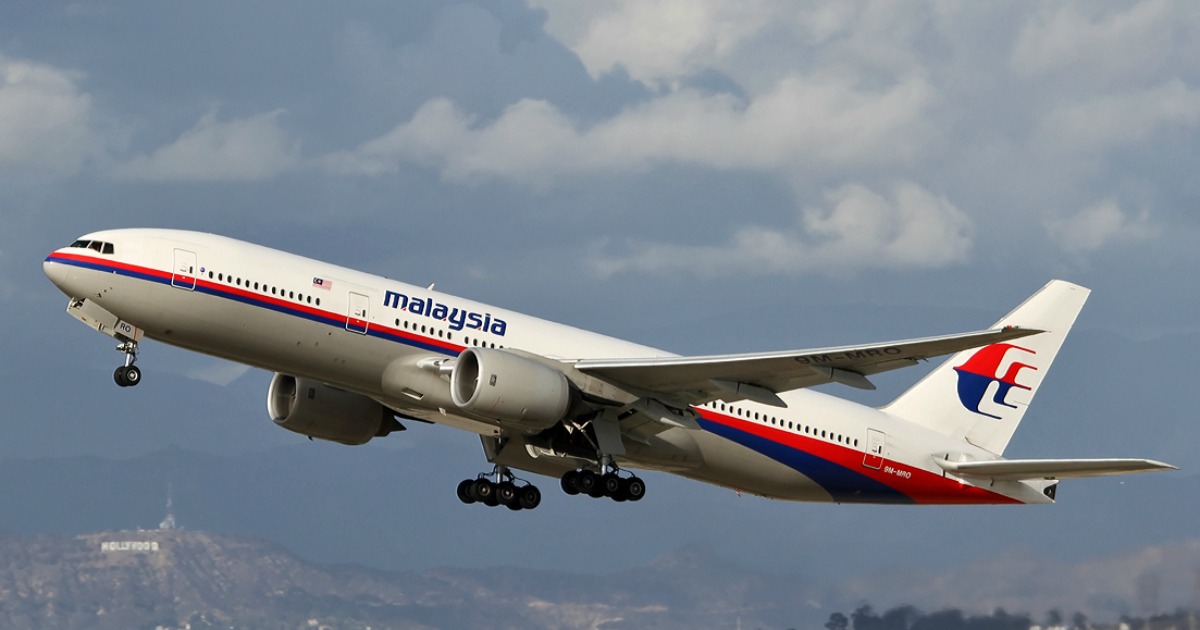

The final known words transmitted from the cockpit of missing Malaysia Airlines flight MH370 have resurfaced more than 12 years after the aircraft disappeared in one of aviation's greatest unsolved mysteries.
On March 8, 2014, the Boeing 777 departed Kuala Lumpur, Malaysia, bound for Beijing, China, carrying 239 people.
However, the aircraft never reached its destination, and despite years of investigations and extensive searches, its main wreckage has never been located.
The mystery has generated numerous theories about what happened during the flight, but investigators have yet to establish a definitive explanation.
What were the pilot's final five words before MH370 disappeared?
The final known radio message from flight MH370 was: "Goodnight Malaysia three seven zero."
The words were transmitted as the aircraft prepared to leave Malaysian-controlled airspace and enter Vietnamese-controlled airspace.
The communication took place approximately 38 minutes after takeoff, while the aircraft was travelling over the South China Sea.
The message was a routine air traffic control sign-off, and nothing in the words themselves indicated that the aircraft was experiencing an emergency.
However, it became the final known voice communication from the flight before contact was lost.
Although the message is commonly attributed to Captain Zaharie Ahmad Shah, the available reporting does not conclusively establish which pilot spoke those words.
The ordinary nature of the transmission has become one of the most haunting aspects of the disappearance.
What happened to Malaysia Airlines flight MH370?
Flight MH370 departed Kuala Lumpur International Airport shortly after midnight on March 8, 2014.
The aircraft was carrying 227 passengers and 12 crew members on a scheduled flight to Beijing.
Initially, the journey appeared to be proceeding normally.
However, shortly after the final communication with air traffic control, the aircraft disappeared from civilian secondary surveillance radar.
Military radar data subsequently showed that an aircraft believed to be MH370 had changed direction, travelling westward across the Malaysian Peninsula rather than continuing towards China.
The aircraft remained visible to Malaysian military radar for approximately another hour before disappearing from radar coverage.
Its last recorded military radar position was approximately 200 nautical miles west-northwest of Penang Island.
What happened after that remains the subject of extensive investigation.
Who were the pilots flying MH370?
The aircraft was commanded by Captain Zaharie Ahmad Shah, an experienced Malaysia Airlines pilot from Penang.
He was 52 years old at the time of the disappearance and had joined the airline as a cadet in 1981.
According to the reporting, Zaharie had accumulated approximately 18,365 hours of flying experience.
The first officer was Fariq Abdul Hamid, 26, who joined Malaysia Airlines in 2007.
He had recorded approximately 2,763 flying hours.
Both pilots became central figures in the investigation as authorities examined the aircraft's movements and possible explanations for its disappearance.
However, no conclusive evidence has established that either pilot deliberately caused the aircraft to crash.
Why did MH370 disappear from radar?
The disappearance from civilian radar occurred after the aircraft's transponder stopped providing the information normally used by air traffic controllers to identify and track commercial flights.
Although civilian tracking was lost, military primary radar continued to detect the aircraft as it travelled away from its original route.
The change in direction prompted questions about whether the aircraft had experienced a technical problem or whether its flight path had been deliberately altered.
Investigators have examined possible equipment failures, communication problems and human involvement.
However, without the aircraft's main wreckage and flight recorders, determining exactly what happened inside the cockpit remains extremely difficult.
How long did MH370 continue flying after contact was lost?
Satellite communication data suggests the aircraft continued flying for several hours after its final radio transmission.
Investigators analysed electronic exchanges between the aircraft's satellite communication equipment and a satellite operated by Inmarsat.
These exchanges helped researchers estimate the aircraft's possible movements after conventional tracking was lost.
The available evidence suggests MH370 may have remained airborne for roughly seven hours after its last voice communication.
Analysis of the satellite data led investigators to focus on a vast area of the southern Indian Ocean.
However, the information did not reveal an exact crash location.
Has any wreckage from MH370 ever been found?
Although the main aircraft wreckage has not been located, several pieces of debris have been recovered around the western Indian Ocean.
One of the most significant discoveries was a wing component known as a flaperon, which washed ashore on Réunion Island in July 2015.
Authorities subsequently confirmed that the component belonged to MH370.
Other pieces of debris linked or potentially linked to the missing aircraft have been recovered along coastlines in the region.
These discoveries support the conclusion that the aircraft ended its journey in the Indian Ocean.
However, they have not provided enough information to establish precisely where the aircraft came down or what caused the disappearance.
What are the main theories about MH370?
Several explanations have been proposed over the years, ranging from an unexpected emergency to deliberate actions involving someone aboard the aircraft.
One possibility is that the plane experienced a serious technical or environmental problem that prevented the crew from communicating or safely landing.
Other theories have examined whether the aircraft was intentionally diverted.
Simon Maskell, a professor in autonomous systems at the University of Liverpool, discussed research examining possible scenarios using Weak Signal Propagation Reporter data.
Speaking to The Diplomat, Maskell said his team's analysis identified three broad explanations that appeared approximately equally consistent with the information they examined.
These included an unusual accident that prevented the crew from communicating, and two scenarios involving a deliberate murder-suicide, differing in whether the person responsible remained alive during the final descent.
However, these were research scenarios rather than established findings.
The methods used to reconstruct aircraft movements from amateur radio signal data have also not conclusively resolved the disappearance.
Why did investigators examine the captain's flight simulator?
During the investigation, Malaysian authorities examined a flight simulator found at Captain Zaharie Ahmad Shah's home.
Data recovered from the simulator included coordinates associated with a route towards the southern Indian Ocean.
The discovery attracted attention because the simulated route appeared to share certain characteristics with the suspected final movements of MH370.
Some commentators interpreted this as potentially significant evidence supporting a deliberate diversion theory.
However, the simulator information did not establish that Zaharie intended to crash the aircraft.
Investigators have not produced conclusive evidence demonstrating that either pilot planned the disappearance.
Consequently, suggestions of deliberate pilot involvement remain unproven.
Why has MH370 been so difficult to find?
The southern Indian Ocean is one of the most remote and challenging areas of the world in which to conduct an underwater search.
Search teams have had to contend with enormous distances, deep water, difficult weather and complex seabed terrain.
Investigators also lacked precise location data from the aircraft's final moments.
Instead, they relied on satellite communications, radar information, ocean drift modelling and other indirect evidence to identify possible search areas.
Even small uncertainties in the aircraft's estimated speed, direction or final descent can produce substantial differences in its possible resting location.
These challenges have complicated repeated attempts to find the wreckage.
What happened to the 239 people aboard MH370?
All 239 passengers and crew members aboard flight MH370 are presumed dead.
The disappearance devastated families across several countries, many of whom have spent more than a decade seeking answers.
The absence of the main wreckage has made the tragedy particularly difficult for relatives, as the precise circumstances of their loved ones' final moments remain unknown.
Families have repeatedly called for continued investigation and further searches to establish what happened.
The mystery has also prompted international discussion about aircraft tracking technology and the importance of maintaining reliable communication with commercial flights.
Will the mystery of MH370 ever be solved?
Finding the aircraft's main wreckage and flight recorders could provide crucial evidence about the final stages of the journey.
The flight data recorder may contain information about aircraft systems, while the cockpit voice recorder could potentially provide insight into events aboard the plane, depending on what data remains recoverable.
However, years of exposure to deep-ocean conditions could complicate the recovery and analysis of evidence.
Search efforts have continued to attract interest from governments, researchers and private exploration companies.
More than 12 years after MH370 disappeared, the final radio transmission remains one of the few confirmed details from the aircraft's last known communications.
Until stronger evidence emerges, the fate of the aircraft and the circumstances surrounding its disappearance remain unresolved.
Sources: VT, Kim Novak, October 28, 2026; The Diplomat interview with Professor Simon Maskell; official MH370 investigation findings and satellite tracking evidence as described in the reporting.